AI and product decisions · DP081
Before staff paste customer data into an AI assistant
Give staff a usable decision process before customer information enters an AI service, including provider settings and downstream copies.
Research cutoff: . This dated explainer is general information; check the linked instruments and your circumstances before acting.

Imagine a support employee who wants help rewriting a customer reply. Pasting the entire conversation is convenient, but the thread may contain an address, an order history and details about another person. The writing task may need only the issue and the proposed resolution.
Give staff a short decision process before information enters an AI assistant. The process should make a useful approved path available, not leave people choosing between an unclear prohibition and an uncontrolled shortcut.
Begin with the task, not the tool
Ask what result is needed: a clearer sentence, a summary, a classification or a decision recommendation. Then identify the information necessary for that result. A template or synthetic example may answer a formatting question without exposing a real customer record.
Removing a name is not always sufficient. A distinctive complaint, address fragment or order reference may still identify someone in context. Review the whole proposed input, including attached files, quoted email history and material retrieved automatically by the application.
The NIST Generative AI Profile treats leakage, unauthorised disclosure or use, and de-anonymisation as relevant privacy risks. Its risk-management guidance supports examining who can access content and how outputs are handled. It is technical guidance, not an Indian compliance certificate.
Check the actual service arrangement
Do not assume that every account, plan or configuration has the same treatment of prompts. Check the service you intend to use: the applicable terms, whether content is retained or used for additional purposes, support access, administrative controls, connected tools and deletion options. Record the version or date of the assessment.
A provider statement about one enterprise arrangement should not be applied automatically to an employee’s separate account. Likewise, a setting that affects model training may not settle every question about logging, human access or downstream integrations. Ask about the whole workflow rather than relying on one reassuring switch.
Where the service sends information to another component, include that recipient in the map. A locally performed step does not, by itself, establish that every earlier or later step remains local.
Place the DPDP decision in the right phase
As of 22 October 2026, the relevant substantive DPDP duties are scheduled for 13 May 2027 under the commencement notification. The future sections 4 to 8 will require assessment of the lawful purpose, processing route, relevant notice and consent where used, and the fiduciary’s responsibilities.
Sending information to an AI service is still a processing decision. A customer’s agreement to receive support does not automatically explain every additional use of their conversation by every service. Determine the parties’ roles and the appropriate route for the actual arrangement before approving it.
Existing applicable obligations also matter during the transition. Do not interpret the later DPDP commencement as permission to ignore confidential information now.
A hypothetical support-writing workflow
A retailer approves an AI-assisted drafting task for its support team. The employee supplies a short description of the problem and the response they intend to send, using placeholders for identifying details. The assistant suggests clearer wording. The employee checks the result and inserts the necessary customer-specific information within the retailer’s approved system.
For a harder case that genuinely needs more context, the employee uses an escalation route instead of expanding the input informally. The responsible owner assesses the additional data and the approved service configuration. The team records the decision without copying the whole customer conversation into a separate approval log.
This is a proposed workflow, not evidence that any named product automatically performs those steps. Its value is that each stage has a clear purpose and owner.
Review the output and the remaining copies
An output may repeat input information, add an unsupported statement or introduce details that should not be sent to the customer. Require an appropriate review before use, especially where the output could affect a person. A helpful tone is not evidence that the content is accurate or suitable.
Include prompt histories, attachments, shared chats, exports and operational logs in the data map. Decide which records are needed and how the relevant retention and access requirements will be applied. Do not assume clearing one visible conversation removes every copy.
The recurring failure is checking only whether the assistant produced a good answer. The privacy decision begins with the input and continues through recipients, output and retained records. A clear, bounded workflow lets staff gain useful assistance while keeping those decisions visible.
Review the data before it enters the assistant
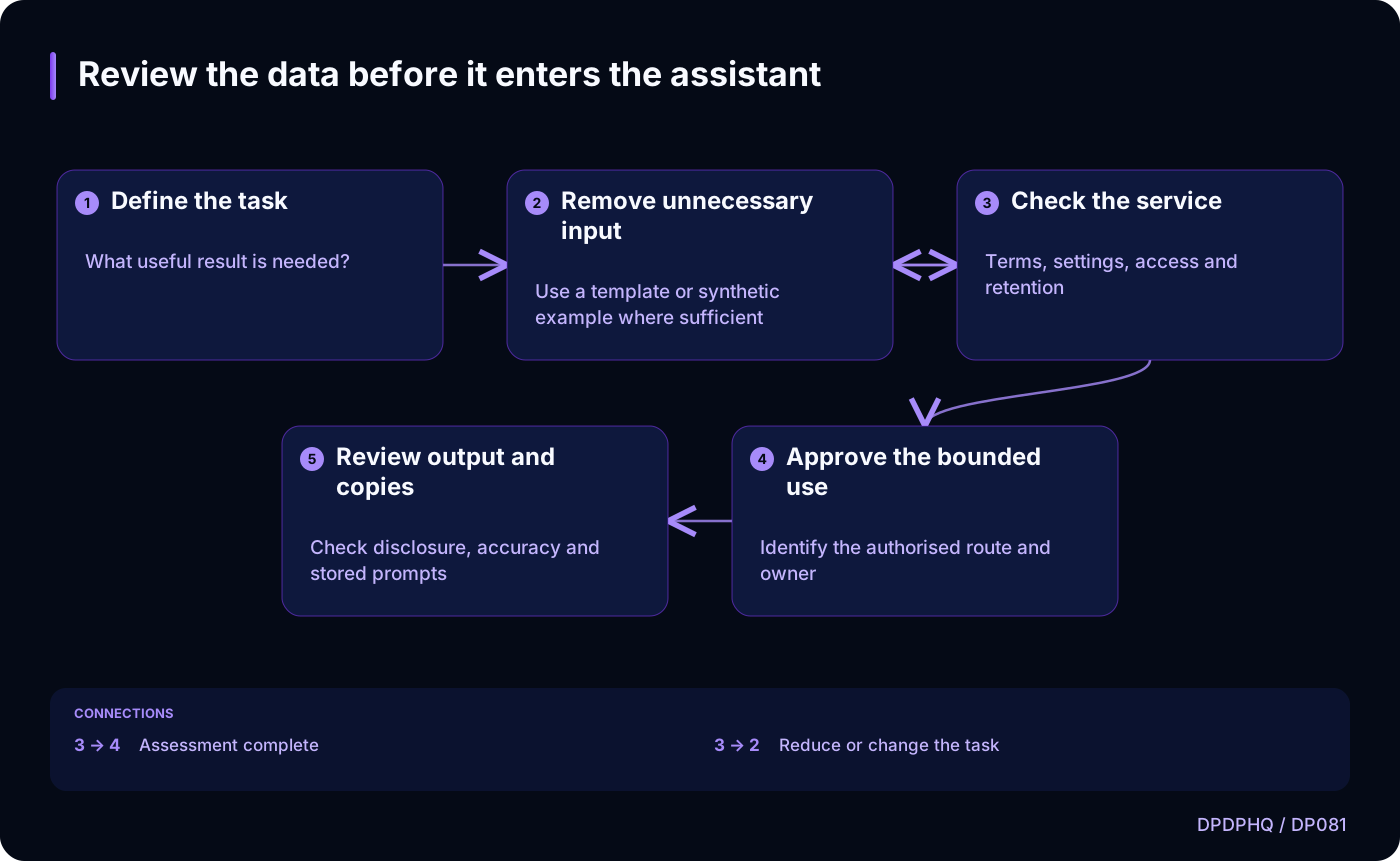
Text version of the diagram
- Define the task: What useful result is needed?
- Remove unnecessary input: Use a template or synthetic example where sufficient
- Check the service: Terms, settings, access and retention
- Approve the bounded use: Identify the authorised route and owner
- Review output and copies: Check disclosure, accuracy and stored prompts
- Define the task → Remove unnecessary input
- Remove unnecessary input → Check the service
- Check the service → Approve the bounded use: Assessment complete
- Approve the bounded use → Review output and copies
- Check the service → Remove unnecessary input: Reduce or change the task
Sources and reading context
These references support the original 22 October 2026 research. Source links and the date above make the scope of this article explicit.
- Commencement notification for provisions of the DPDP Act · paragraph (c)
Dates future DPDP duties
- Digital Personal Data Protection Act, 2023 · sections 4 to 8
Purpose, consent where relevant and accountability
- NIST AI 600-1: Generative Artificial Intelligence Profile · Data privacy risks and suggested actions
Supports mapping content access and disclosure risks