Employment and service sectors · DP079
Event registration lists should not become unrestricted sponsor leads
Separate event administration from sponsor lead sharing and keep each participant’s relevant choice attached to the handoff.
Research cutoff: . This dated explainer is general information; check the linked instruments and your circumstances before acting.

Consider a hypothetical participant who registers for a conference to attend sessions. After the event, several sponsors begin contacting them about products they never discussed. The organiser may see sponsor access as part of the event’s commercial model, but the participant may have understood registration very differently.
Keep event administration and sponsor lead sharing distinct. The data needed to issue a pass or communicate a schedule change does not automatically explain an unrestricted distribution list for every partner.
Define each proposed handoff
List the recipients, purposes and fields before designing registration. A sponsor receiving a contact detail for an expressly requested follow-up is a different arrangement from all sponsors receiving the complete attendee database. Avoid a broad ‘trusted partners’ phrase where it hides the decision the person is being asked to make.
As of 22 October 2026, the substantive DPDP provisions discussed here are scheduled for 13 May 2027 under the commencement notification. The future sections 4 to 7 will require an appropriate processing route for the purpose. Where consent is relied on, rule 3 and the Act’s notice and consent provisions will shape the explanation and choice.
Assess the parties’ roles. A sponsor deciding its own follow-up campaign may not be merely a processor acting on the organiser’s instructions. The contract and the actual use should reflect the relevant relationship rather than assigning a convenient label.
Make the interaction understandable
Explain what happens when a participant selects an option or presents a badge for scanning. A scan can record an action, but its meaning depends on the information given and the actual purpose. Do not treat every scan, including an entry scan, as evidence of consent to unrelated marketing.
Use the least data needed for the agreed handoff. A sponsor follow-up may not need dietary requests, accessibility information, payment records or internal organiser notes. Keep those event-service fields out of lead exports unless a distinct, justified purpose and route have been assessed.
Test the decline path. Refusing an optional sponsor-marketing use should not prevent ordinary attendance. If processing is said to be necessary for a particular service, assess that necessity and the applicable consent conditions rather than assuming that clearly explaining a bundled condition makes it valid.
A hypothetical regional trade event
An organiser runs a regional business event with several exhibitors. Registration creates an attendance record and the contact route needed for event communications. Sponsor follow-up is handled separately through a clearly described interaction at the relevant stand.
The organiser tests a synthetic attendee who attends sessions but does not request sponsor contact. That record does not appear in the sponsor export. A second test record requests a specific exhibitor’s follow-up, and the export contains only the fields relevant to that request and the associated decision evidence.
The test also reveals that a registration-platform default would have included a free-text accessibility note. The organiser removes that field from the export and checks the resulting file before any real handoff. The improvement comes from inspecting the data, not simply changing the consent wording.
Give sponsors usable instructions and boundaries
Document what the recipient may do with the lead, what evidence accompanies the handoff, who handles a correction and how a withdrawal or complaint is routed. A sponsor should not need to guess whether the record represents an attendance scan, an enquiry or a promotional choice.
Where a supplier processes on the organiser’s behalf, the future section 8(1) accountability framework remains relevant. Where the sponsor has its own role, assess that role and the applicable duties separately. In both cases, a clearly defined handoff is more useful than a list described as ‘all leads’.
Apply appropriate access controls to downloads and temporary working files. The future rule 6 safeguards will be relevant; an export held on an unrestricted shared drive is part of the risk even if the registration platform is well configured.
Plan the follow-up lifecycle
Under the coming section 6(4) to 6(6) framework, consent withdrawal will need comparable ease and action on the affected processing within a reasonable time, subject to the statutory qualification. Decide which party receives a request and how the relevant recipient list is updated.
Do not promise that changing the organiser’s preference field automatically changes every independent sponsor’s system. Build the appropriate notification and responsibility process, and explain its scope accurately.
The recurring failure is treating the event’s commercial arrangement as if it were the participant’s decision. Keep the attendance purpose, sponsor interaction and later campaign distinct, then test that the exported audience matches the choice the person actually made.
Separate event access from sponsor contact
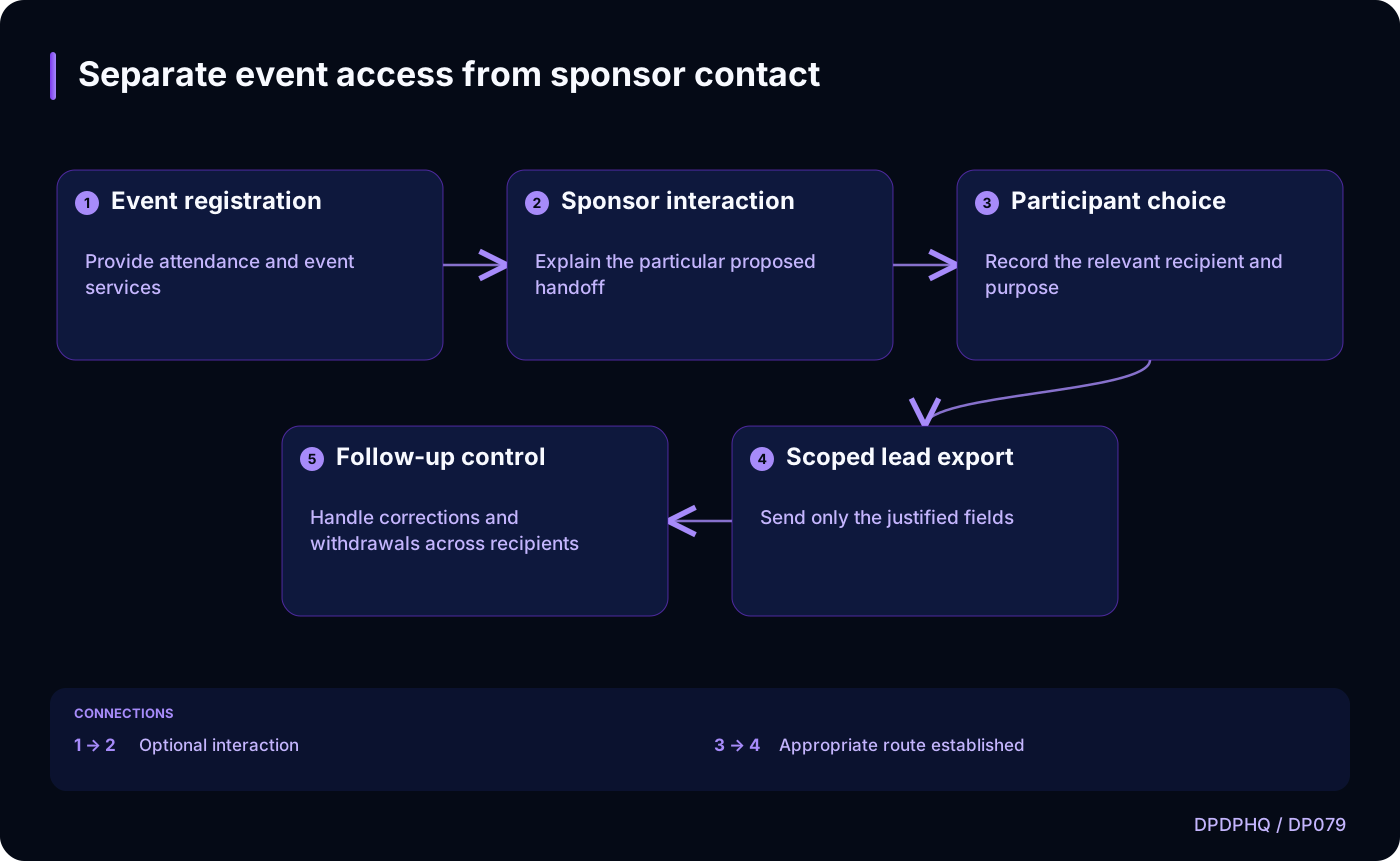
Text version of the diagram
- Event registration: Provide attendance and event services
- Sponsor interaction: Explain the particular proposed handoff
- Participant choice: Record the relevant recipient and purpose
- Scoped lead export: Send only the justified fields
- Follow-up control: Handle corrections and withdrawals across recipients
- Event registration → Sponsor interaction: Optional interaction
- Sponsor interaction → Participant choice
- Participant choice → Scoped lead export: Appropriate route established
- Scoped lead export → Follow-up control
Sources and reading context
These references support the original 22 October 2026 research. Source links and the date above make the scope of this article explicit.
- Commencement notification for provisions of the DPDP Act · paragraph (c)
Dates substantive duties
- Digital Personal Data Protection Act, 2023 · sections 4 to 7, 6(4) to 6(6), 8(1)
Processing routes, withdrawal and accountability
- Digital Personal Data Protection Rules, 2025 · rules 3 and 6
Notice and safeguards